Floors &
thresholds
Notice where movement meets material. Keep changes in reflection, joints and the edges of the room together in the record.
THE WIDER VIEWA closer look at the surfaces we already have. An imagined stone-care practice, built around material, character and the possibility of keeping.
Explore the surfaces A FICTIONAL MATERIAL PRACTICE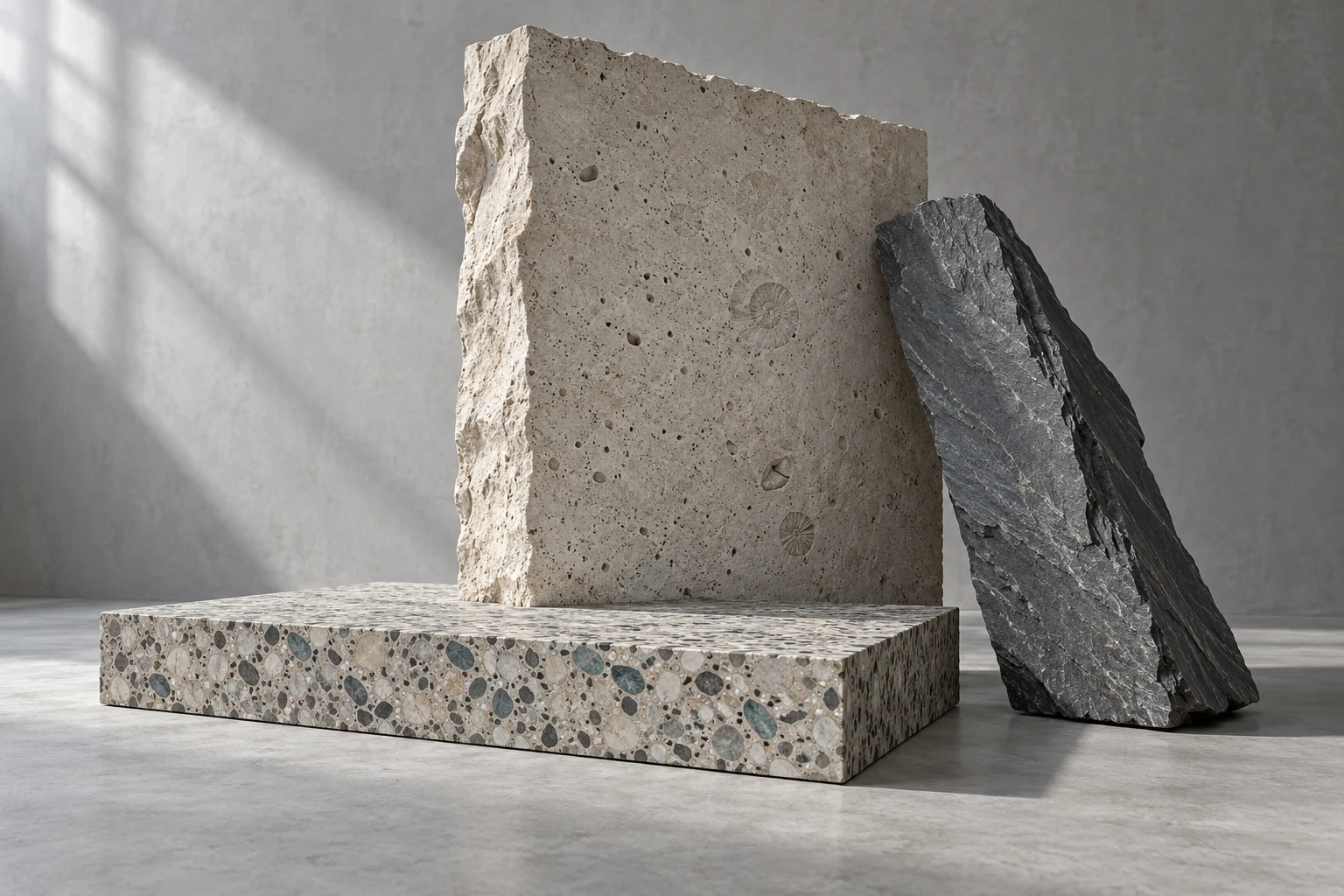
Material has a past.
Give it a place in what comes next.
A lived-in surface holds a record of the room around it. A familiar threshold. The corner of a step. A grain that catches the afternoon light.
The first move is attention. This imagined practice begins with what is already there, what makes it particular, and what we still need to understand before anything changes.
Choose a material. Look at a concern.
Keep the observation specific.Original illustrative studies.
No diagnosis or before-and-after claims.
The cloudy area in this limestone study softens the small pores and changes the reflected light. Its appearance alone cannot tell us what caused it.
Does the change stay visible when the light moves across the surface?
There is the face you see. The edge you meet. The joint that holds the rhythm of a room. Each deserves its own observation.
A useful material record keeps those relationships in view. It also leaves space for what a photograph cannot tell us.
Depth is part of the story.
Original generated texture with authored geometry.
From a whole floor to the edge of a step, the setting matters as much as the surface.
Notice where movement meets material. Keep changes in reflection, joints and the edges of the room together in the record.
THE WIDER VIEWLook at the profile as well as the face. Describe the location and extent of a change without disturbing the surface.
THE POINT OF CONTACTA small piece can carry the character of a whole space. Keep its surrounding materials and original setting in sight.
THE SMALLER STORYIllustrative practice scope only. No assessments, treatments, visits or estimates are offered through this concept.
Describe the visible change and the conditions in which it appears. The angle of the light is part of the observation.
Keep what is known separate from what is assumed. Material identity, past work and condition need their own evidence.
Keep useful questions beside the observation. A clear record is a starting point, without a promised outcome.
Give an imagined project a working title. Keep the material, the concern and one useful observation together.
Only in this page.
Nothing sent or saved.
No personal information.
A few useful things to know
about this imagined practice.
No. STONE CYCLE is an original fictional design concept. It does not offer visits, estimates, treatments or commercial availability.
No. The images are original generated material studies. The explorer adds authored visual concerns to help describe a surface; it does not show real damage, a diagnosis or a restoration result.
A photograph can help record an observation, but it cannot establish material composition, condition or a suitable intervention. This page provides no treatment or chemical instructions.
Nowhere. The note exists only in this page’s current memory. Nothing is submitted, saved, uploaded or booked. Reloading the page clears it. Please keep personal and sensitive information out of the note.